

Showing posts with label inventor. Show all posts
Showing posts with label inventor. Show all posts
Saturday, April 12, 2014
Friday, March 21, 2014
Mean Mr. Edison
10 Ways Edison Treated Tesla Like a Jerk
Thomas Edison has over a thousand patents in his name. Some of them
are even based on his own ideas. But more often than not, he was
working off another great innovator’s findings, and tinkering until he
produced something that could make a buck or two. He is often praised
for having invented a number of household items we take for granted,
and couldn’t live without. But considerably less credit is actually give
to the genius scientists and inventors who worked under his employ to
make him rich (and a household name). One of those men is Nikola Tesla,
who got an incredibly short end of the stick, and whose brilliance often
goes unacknowledged and under-praised beneath Edison’s blinding
overcast. Here are ten ways in which Edison was a real jerk to Tesla.
10
Disrespectful

Towards the end of Edison’s life, he was quoted as saying he wished he
respected Tesla and his work more than he had. Too bad, at that point the
damage had been done; Tesla died broke and lonely, while Edison died
wealthy and with great self-esteem. While they had worked together
Edison had often called his ideas "impractical" or mocked them (if he
wasn't plain threatened by them). It seemed Edison knew that he had
this brilliant young mind under his thumb from the moment he came to
America to work for him. (At that point he already had a few patents in
his name, for devices that operated by rotating magnetic fields.)
9
Driven by Greed

Tesla once criticized Edison by saying in a New York Times interview, “He had
a veritable contempt for book learning and mathematical knowledge, trusting
himself entirely to his inventor’s instinct and practical American sense.”
Wheras Tesla was an impassioned engineer who seemed to be utterly fascin-
ated by the technical aspects of his work. He had a photographic memory, could
memorize entire books, and used to have literal flashes of genius where he’d
conceive the solution to a problem, or visualize the detailed schematics of a
device he’d yet to invent. Edison insisted on developing (or replicating and
patenting) devices that had some practical utility (something that could make
him money), never just science for purely science.
8
Mocked Tesla’s Line of Thinking

Not only did he call some of Tesla’s brilliant ideas impractical, or have
potential inventions of his shut down, he just didn’t seem to value Tesla’s
mind. Tesla, who worked late into the night, remained celibate until his
death at 86, was an eccentric and often obsessed over his work. Edison,
however, was more socially functional (well, he had a 16-year-old wife,
if that counts as proof), and didn’t take Tesla often highly esoteric
comments entirely seriously.
7
Took Credit for the Fluoroscope

The fluoroscope – a device for producing X-ray images – is something
Tesla had been working on prior to Edison’s pig-headed dabbling. In
the process, Edison managed to give his assistant terminal cancer
(who had to have his arms removed before he ultimately died),
and he almost blinded himself. But he sure got that patent all right.
Tesla had been working on prior to Edison’s pig-headed dabbling. In
the process, Edison managed to give his assistant terminal cancer
(who had to have his arms removed before he ultimately died),
and he almost blinded himself. But he sure got that patent all right.
6
Wouldn’t Pay Up

Edison backed out of paying Tesla $50,000 to fix his DC motor – which
Tesla did with great ease. He managed to turn an inefficient device into
something incredibly efficient that saved Edison all sorts of money (well
more than he agreed to pay Tesla). All he said was that Tesla failed to
“understand the American sense of humor” (Tesla was a Serbian im-
migrant). More like he failed to realize how much of a stingy two-timer
Edison was. Edison offered to up his pay from $18 a week to all of $25.
Tesla, not a moment too soon (but far too many too late), resigned.
Thereafter he wound up digging ditches, before starting his own
company and accepting investments to do some experiments in
his own right.
5
Meddling Fool

Edison has a Medal Named After Him, Which Tesla Was Awarded.
The Edison Medal is presented yearly by a group called IEEE, or
the “Institute of Electrical Engineers” (a group of Edison’s friends)
It is an outright slap in the face that Edison’s name is paraded by
an award in the field (one he is not truly a part of) of which Tesla is
an exceptional, shining example. A greater slap in the face still was
when Tesla was awarded the Medal in 1916.
4
Early Radar Technology Laughed Off

If Edison hadn’t deemed one of Tesla’s most crucial radio wave-base
innovations to be “impractical” back during World War I– when he first
proposed plans for such–countless lives could have been saved for
having the advantage of being able to detect enemy submarines. Of
course it would be actualized until decades later. But just to think of
what damage Edison’s ego-driven meddling has cost time and again
is infuriating.
3
Fought against Tesla’s AC Power

Simply put Edison (with a few other moguls on his side) didn’t want to see
Tesla’s Alternate Current succeed, because it posed a (fiscal) threat to the
viability of his Direct Current (which Tesla had previously souped up for
him). A bitter public battle took place, with George Westinghouse of the
Westinghouse Company on Tesla’s side. Edison sought to use spineless
scare tactics to convince the public his AC units weren’t safe. In order to
“prove” this “fact,” he had a number of animals electrocuted, including a
circus elephant (which was to be put to death for killing a some people).
Ultimately, Tesla won this “War of Currents,” only because he indeed had
the better power mechanism. Although the current of success swept into a
place of high regard, he forewent obscene wealth so as to–in a show of
unprecedented humility–save the Westinghouse Company (which would
have gone broke with the royalty payments). Instead, Tesla made a few
grand by just selling his patents outright. To view the full infographic
above, go here.
2
Killed a Man to Prove Tesla Wrong

Edison was known for his intimidation tactics (e.g. he used to hire a bunch
of goons to smash technology and make sure he got his dues for his
patents), but never did it get so bad as with his campaign against Tesla;
he went so far as to invent the electric chair, using Tesla’s AC power to
have a man on death row executed. The event was gruesome and messy,
drawn out. George Westinghouse was quoted to have said, “They would
have done better using an axe.” And so the first execution by electric chair
took place, just to prove Tesla wrong (and preserve Edison’s financial
stakes).
1
Shared Virtually None of His Wealth

Edison was a wealthy man, and always finding new ways to get
wealthier. That meant rushing his crude discoveries and unoriginal
devices to the patent office to secure his royalties. While Tesla was
largely a one man technology-synthesizer, Edison had buildings
stocked with brilliant engineers and scientists who did all his bidding,
while he took the lion’s share of the revenue for himself. Tesla just
happened to be one more sucker to get trapped in his greenhouse
of genius, where all he need ask for is a few drops of water and sun-
light to churn out unrelenting yields.
Saturday, March 15, 2014
Arminian Antics #126

Just a reminder...the best way to view Sola Bootstrapa (Arminian Antics) is to right click and open link in new window using the provided magnifying glass...
Saturday, March 8, 2014

Saturday, March 1, 2014

Friday, February 14, 2014
History Channel on Nikola Tesla
When I see the word history I always think of His story as I'm sure a lot of you do. It's evident that God uses people from all walks of life to accomplish His will and purposes. I am reminded of an atheist who, after recovering from a near fatal incident, told me in the hospital that he thanked science for his recovery and healing. That is like thanking Sherlock Holmes for solving all the crimes in the detective novels he appears in and forgetting Mr. A. Conan Doyle, the author of the entire series. God is the Author and Finisher, the Cause and Completer, The Alpha and Omega, The Beginning and the End, The A and Z and all the letters in between of our faith -- and the jot and tittles of history itself. Enjoy the film. It's well worth the 45 minutes.
Wednesday, December 18, 2013


Monday, December 2, 2013

Saturday, October 12, 2013
From Fear to Favor
This rare, digitally restored full-feature cartoon features Superman, in his first animated movie (1942) where he battles a character based on Nikola Tesla, the Mad Scientist (who has a raven rather than a pigeon) . Animated by the award-winning Max and Dave Fleischer Studios of the 1940s, it demonstrates how Tesla was turned into a mad scientist by the mainstream media.
Today, he is viewed by DC comics ("DC"-ironic, isn't it) for the peace loving genius he was, as demonstrated by the comic below.

This story offers up yet another twist to the "What if Superman had landed (where/when)...?" scenario, but still stands out as a great story to read. The premise is that the DC universe characters existed--in some form or another--during the latter decades of the 19th century. Clark Kent, sans costume or need for a secret identity, makes his debut at the Centennial Exposition in 1876, when he flies in carrying the first pieces of what would be the Statue of Liberty.
Kent's goal is to offer his strength, speed, and other talents to top scientists in order to speed up the already dizzying pace of scientific progress. He takes a job with Thomas Edison, but soon after forms a coalition with genius inventor Nikola Tesla and financial wizard Lex Luthor. It is through the progress of science and the happy accidents it sometimes breeds that his various co-workers--Ted Knight and Barry Allen--are transformed into the Starman and the Human Flash. A stranded alien later offers Clark the ring of the Green Lantern Corps, but Clark refuses it, allowing it to pass instead to Army Captain Hal Jordan.
The goal of the newly formed League of Science is to promote the use of science to help the common man. But it doesn't always work that way, particularly when the common man is the one who has to build all of it for low wages.
Toss into the mix a romantic feud between Kent and Luthor over the love of Lois Lane, Luthor's own ideas for building science-based weaponry using radium, and the betrayal by one of the other League members, and what you have is a historical superhero drama set against the backdrop of an Industrial Revolution gone horribly awry. (review by R. J. Carter)


Monday, October 7, 2013
Real Deal History (T or F) #1

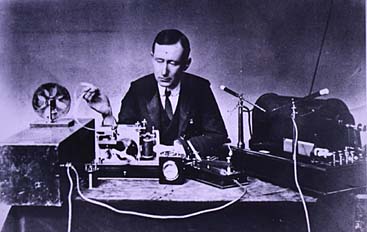
Guglielmo Giovanni Marconi at desk
In this new series (and the next five days) you will learn more about historical figures than many textbooks care to acknowledge. First up , is Marconi. These five statements below are either true or false. Before you let your fingers run to Google, try answering these questions by yourself. Answers will be posted in a few days Have fun and prepare to have your eyes opened.
1. Marconi was the inventor of the radio.
2. Part of his name (which I left out under the above photo) is "Maria".
3. At his wedding, Marconi's best man, was Fascist dictator, Benito Mussolini.
4. The Starship song "We Built This City" mentions Marconi.
5. Marconi was a member of the Fascist Grand Council.

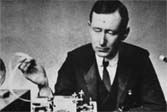
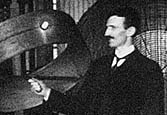
In the quiz above, every statement is true - except the first.
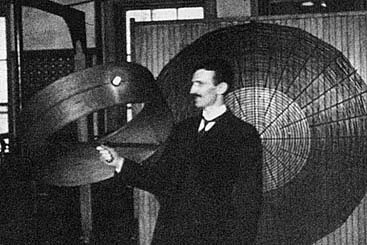
As early as 1892, Nikola Tesla created a basic design for radio. On November 8, 1898 he patented a radio controlled robot-boat. Tesla used this boat which was controlled by radio waves in the Electrical Exhibition in 1898, Madison Square Garden.
Tesla's robot-boat was constructed with an antenna, which transmitted the radio waves coming from the command post where Tesla was standing. Those radio waves were received by a radio sensitive device called coherer, which transmitted the radio waves into mechanical movements of the propellers on the boat.
Tesla changed the boat's direction, with manually operated controls on the command post. Since this was the first application of radio waves, it made front page news, in America, at that time.
Most of us, think of Guglielmo Marconi as the father of radio, and Tesla is unknown for his work in radio. Marconi claimed all the first patents for radio, something originally developed by Tesla. Nikola Tesla tried to prove that he was the creator of radio but it wasn't until 1943, where Marconi's patents were deemed invalid by the U.S. Supreme Court and due credit given to Nikola Tesla - thus restoring Tesla (who had died a few months earlier) as the inventor of the radio.
Thursday, April 25, 2013

Astounding Mind - Nikola Tesla
Take the time to find out about Tesla. He is the genius some say invented the twentieth century. Everyday you benefit from his inventions, yet relatively few have heard of him. One thing for sure...you'll never think of Edison the same.
Friday, April 12, 2013
Dave Hunt's 1918 Invention


Yes! This is the same Dave Hunt who wrote, "What Love is This?"( His reply to the 5 Points of Calvinism.) During our research on Evangelical Inventions of the Past we uncovered this contraption that claimed to give instant Arminian apologetical responses to any Calvinistic question that might pop up during a Bible study, preaching session or casual conversation. This device was first sold at Dave Hunt's John 3:16 conference and pot-luck supper in Misconstrue, Washington and was hailed by Arminians everywhere as the "single most sure-fire anti-Calvinist super weapon thingy that ever was." Hunt had to discontinue it's use after several participants became Calvinists anyway.

Sunday, March 3, 2013
Visiting Relatives in the Past

Friday, November 2, 2012

Friday, February 11, 2011
Science and Invention

Science can be a cruel mistress.
Although, sometimes we all benefit from scientific breakthroughs!

Hmmmm....complete with vegetables and stuffing!
Monday, January 19, 2009


Subscribe to:
Posts (Atom)
